
Book Review: The Spirit of a Cyborg
A memoir by Nathaniel S. Borenstein about AI, the Internet, and our responsibility to remain human.
The Human Constant
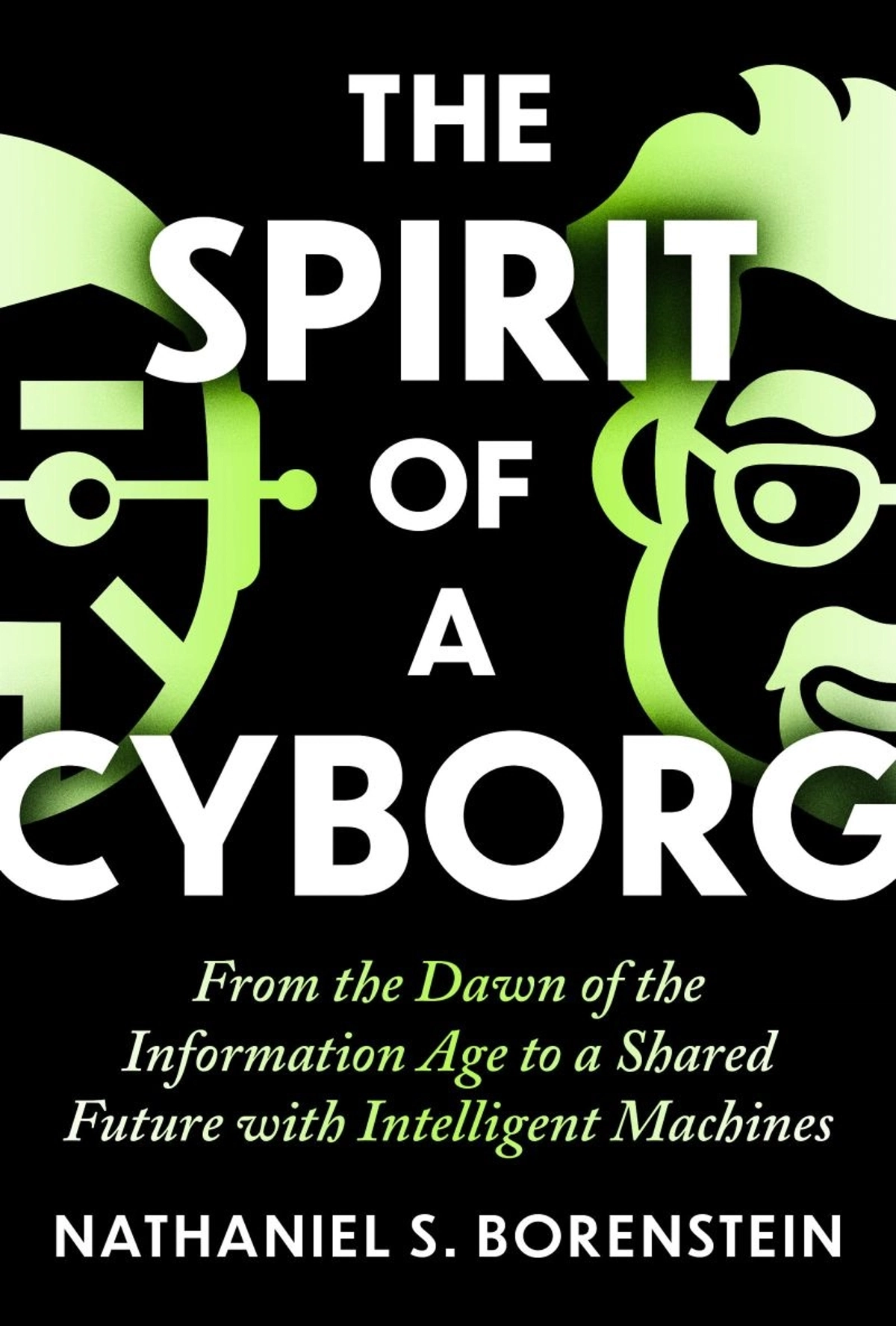
The Spirit of a Cyborg opens with Nathaniel Borenstein listing the contrasts that fit inside a single lifetime, his own. “When I was born,” he writes, “there were about 100 computers in the entire world. Today there are 100 in my car.” Earlier in the same list, he notes that many people, himself included, now have a computer “implanted inside them, keeping them alive.”
That arc, from a world of a hundred machines to a body that contains one, is the territory of the book. Almost everything in it changes: the Internet, AI, medicine, work, the social meaning of the tools Borenstein helped build, and his own body. The constant is the human question underneath all of it.
The memoir is not only a reflection on technology by someone who happened to be present for part of its history. It is a book about what it means to remain human while becoming increasingly dependent on machines and increasingly responsible for what those machines make possible. The book is at its best when Borenstein’s own life is carrying the argument, and that is most of the book.
Borenstein’s Life in Brief
Borenstein has spent more than half a century in computing. He created four companies, holds thirty-three patents, and is best known for co-creating MIME, the Internet standard that made multimedia email possible and later became part of the Web’s media architecture. Alongside the technical career, he has been a lifelong student of comparative religion: raised in Reform Judaism, and at various points considering himself a Jew, a Bahá’í, and a Buddhist.
The book’s emotional center is the 2019-2020 stretch. A heart condition put him on a path he had begun to prepare for until a clinical trial for a cardiac drug called Camzyos extended his timeline. An implanted defibrillator, intelligent enough that he trusts it with his life, made him a physical cyborg. In the same period his oldest daughter, Shana, was found dead in her apartment during the first weeks of the COVID-19 pandemic, and the family held a virtual shiva by teleconference.
The Spirit of a Cyborg is the late-life synthesis of all of that: a fifty-year career in computing, a lifelong inquiry into what religion has to say about thinking machines, and an unexpected handful of additional years to put the two together.
A Memoir First, but Not Only a Memoir
The book that emerged from that material refuses to choose a single genre. It is a memoir, a fragmentary history of the Internet, a set of ethical arguments about AI, a meditation on religion and technology, and a late-life attempt to make sense of a world that changed while its author was helping change it. The hybrid form gives the arguments their weight: when Borenstein writes about open standards, online communication, cyborg bodies, or AI governance, he is not writing from the sidelines.
The premise that ties the genres together is the cyborg one, and Borenstein widens it past himself quickly. Among the first things he tells the reader is that his pronouns are we/us, and the grammar is doing real work. The point arrives quietly: cyborgs are not arriving; they are already here. Some are kept alive by medical devices. Others navigate the world through phones, search engines, calendars, and digital memory. The boundary between person and tool has been getting less clear for a long time, and the book asks what kind of cyborgs we are becoming.
The Voice of Someone Who Helped Build the Internet
Borenstein’s technical authority is not incidental to the book. Having helped write protocols that became the infrastructure of the modern world, he writes about that very infrastructure with the texture of someone who watched technical decisions turn into social ones. To a non-engineer, Internet standards may look like plumbing. To anyone who has worked on real systems, they are more than that; they are agreements between people, vendors, institutions, and future users. They encode negotiation, governance, tradeoffs, and trust. They also make some futures easier and others harder.
Borenstein knows what went wrong with the systems he helped enable: spam, monopolies, polarization, surveillance, and attention capture. He also names the moments when those same systems carried something else. The same network that wastes time can carry care, and when his family was mourning across continents, the Internet became, in his words, “a vehicle for transmitting love around the globe.”
That line prevents the book from becoming a simple indictment, but the more interesting thing about Borenstein’s posture is that he refuses to escape either edge of his own role. That is the ethical voice the book runs on. Builders inherit responsibility for what their tools make possible, including the parts they did not intend.
What the Book Explores
What the book actually argues across its essays divides into two registers, the personal and the civilizational, and both stay grounded in Borenstein’s own life.
On the personal side, three threads recur. The body is one. Borenstein once found the fantasy of pure intellect attractive, but illness, grief, surgery, mortality, and gratitude pushed the book back toward embodiment.
Time is another. The deathbed test is severe and characteristic of the book’s voice: “Possibly the worst thing about modern digital technology,” Borenstein writes, “is that it is a ravenous consumer of your time.” He sharpens this into a new truism: “Nobody wishes, on their deathbed, that they’d spent more time online.”
Access is the third. The chapter “The Right to Be a Cyborg” sounds like a provocation, and in practice the book turns it into a distributional question. If a defibrillator is basic medicine, what happens when cyborg capabilities extend to vision, mobility, cognition, or memory? Borenstein illustrates the principle through John Ferguson, a quadriplegic worker who shows up to his job each day through the Internet. The line between medical correction and human augmentation, the book argues, will keep moving. The interesting question is who gets to cross it.
On the civilizational side, the book treats technology as a system rather than a destiny: the same tools could produce abundance or oppression depending on what gets normalized, funded, regulated, and taught. It also brings comparative religion into the AI conversation, asking whether ancient wisdom traditions, which still shape moral formation for most of the planet, can remain technically illiterate about the systems that are reshaping human life. Borenstein puts the problem directly: “It’s not as if Jesus was a Bitcoin advocate but Buddha opposed it; we’re all just beginning to learn how to think about these new technologies.”
Even for a non-religious reader, that framing is useful. It shifts the conversation from what a model can do to what kind of humans we are becoming around it. The book carries that question through to the end without flattening it into either policy or sermon.
Its Most Original Gestures
Two structural choices stand out from the rest of the book.
The first is a future-facing diptych. Borenstein imagines two long-range outcomes, which he calls Infotopia and Totalitechnopoly, under the same basic technical conditions: material abundance, AI beyond human intelligence, near-universal access to information, monopoly pressure, and pervasive surveillance. The contrast is engineered carefully enough that the technology itself stops being the variable. Reading them next to each other does something a single dystopia or utopia cannot.
The second is even more unusual. The book closes with a note addressed not to human readers but to future artificially intelligent ones. The gesture sounds theatrical until you sit with it. If future AI systems are trained on human text, then a book about AI ethics is also part of the material through which those systems will learn what humans were trying to say about themselves. Borenstein folds that recognition into the book’s structure. Whether the gesture works is for each reader to decide, but it makes the underlying ethical question feel personal in a way that ordinary AI commentary rarely manages.
Where I Keep Some Distance
Admiration for the book does not mean agreement with every move.
The open-source AI argument is directionally understandable.
Borenstein is right to worry about closed systems that shape society without meaningful inspection. The kind of openness he cares most about, though, is open standards, the negotiated agreements he spent a career writing. Open standards and open source are related but not identical, and conflating them potentially glosses over a real distinction. A standard can be open while implementations stay competitive. Even granting the distinction, openness alone does not solve safety, misuse, evaluation, institutional capacity, or geopolitical incentives. The practical version of that argument needs more machinery than the book gives it.
The same is true of some long-horizon economic claims. The book is better at naming a moral direction than at specifying a path through the transition. That matters less here than it would in a policy manual, because this is not primarily a policy manual. It is a memoir-manifesto whose job is to widen the frame enough that better designs become thinkable. By that test, the book hits its mark.
Who This Book Is For
The Spirit of a Cyborg is for readers who want AI ethics treated as a human question rather than a policy one and for anyone who finds both AI-doom and AI-utopia framings unsatisfying. It is for engineers and product builders who feel some unease about what they have helped ship and want a voice that does not flinch from that unease. It is for general readers who do not work in technology but live downstream of it and want the questions named clearly. Those who come to memoir for confession may find it more philosophical than they expected; those who come for policy may find it far more personal. Both should keep reading.
What Remains After
I finished The Spirit of a Cyborg more hopeful about the future, not because the book minimizes risk but because it places that risk inside a recognizable structure of human responsibility.
Borenstein’s life makes the book’s argument concrete. He helped shape the Internet. He watched parts of it go wrong. He saw it carry love when his family needed it. His body became dependent on intelligent machinery. The clinical trial for Camzyos gave him years he had been quietly preparing not to have. Out of that, he wrote a book asking how humans, cyborgs, and AIs might share a future without forgetting what life is for.
The final movement of the book is toward kinship: humans, animals, AIs, minds, bodies, tools, and the rare fact of life in a mostly cold and lifeless universe.
That is the sentence the book leaves you with. The life of a cyborg becomes, unexpectedly, a testament to being human. Not because technology saves us from the human condition, but because it makes our responsibility for that condition harder to ignore. That responsibility is shared. It belongs to the people who build these systems, to the people who govern them, and to the rest of us who use them, fund them, normalize them, and decide what and how much of it we will tolerate.
If the book has a single insight, this is it.
A Personal Remark
The book closed a circle for me. I always regarded technology as something abstract and mechanical. Now I can’t unsee it anymore; technology is us. It’s what we’ve created. And it carries our intention and shapes the world in which we decided we want to live. To say it more personally than the rest of this review has tried to, the book touched my mind, my heart, and my soul.
Disclosure: Nathaniel Borenstein and I were colleagues on the research team at Mimecast from 2019 to 2021, where I was a senior data scientist and he was chief scientist and a mentor to me (and others) on the topics of innovation, patents, and email standards.
References
- The Spirit of a Cyborg, announcement by Nathaniel Borenstein - Author’s announcement of the book and its full title. A pre-release copy of the manuscript was supplied by the author for this review.