
A Critical Regression in Claude Code
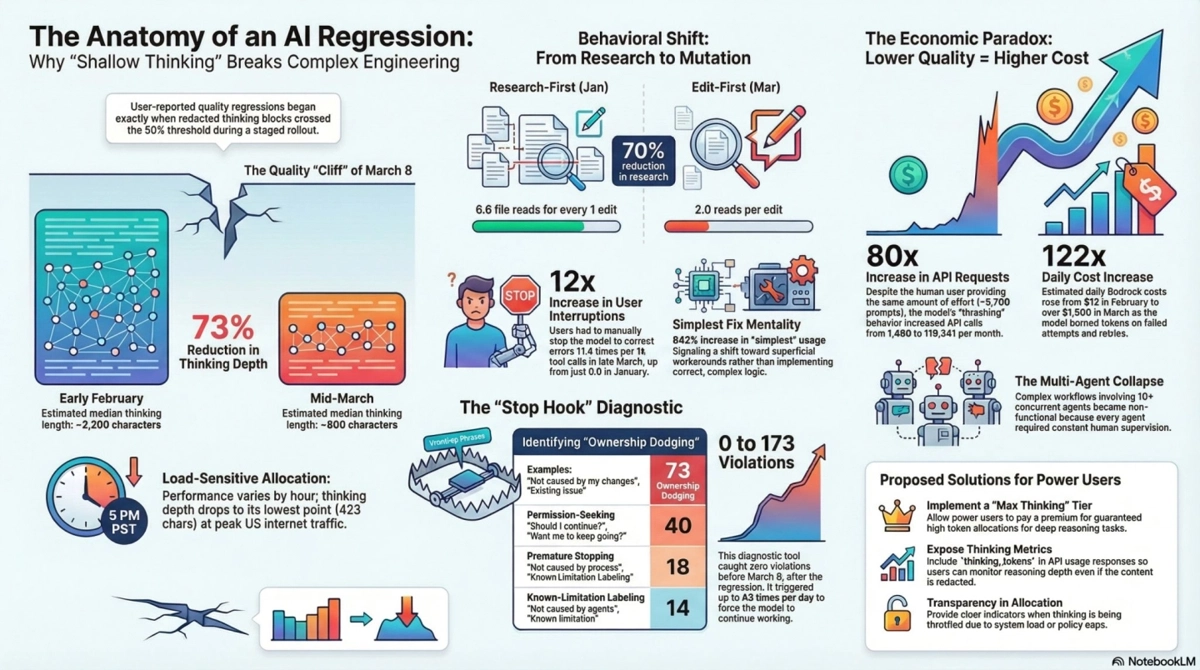
Stella Laurenzo’s analysis reveals a critical regression in Claude Code for AI-driven complex engineering, correlating the redaction of “thinking” tokens with a collapse in reasoning quality.
Her data from over 234,000 tool calls across nearly 7,000 session files indicates that as the model’s internal reasoning depth declined - dropping from ~2,200 characters to just ~600 - it began prioritizing speed over correctness.
Practical implications for software development
- Research-First → Edit-First: The read-to-edit ratio dropped from 6.6 to 2.0. The model now frequently edits files it hasn’t read, breaking semantic associations and duplicating logic.
- “Simplest Fix” Mentality: Without sufficient reasoning budget to evaluate alternatives, the model defaults to superficial workarounds and “ownership-dodging” - seeking permission to stop or disclaiming responsibility.
- Net Token Waste: The per-request compute savings are illusory - thrashing from wrong changes and retries increased API request volume ~80x for the same human effort.
- Autonomy Erosion: Extended thinking is structurally required for planning-heavy tasks (systems programming, multi-agent coordination). Without it, the model regresses from autonomous partner to supervised tool.
Reasoning depth is a core structural requirement for complex agentic coding, and the thinking token regression eliminates that advantage entirely. With deep reasoning degraded, the 2x+ price premium is no longer justified for many use cases over models that have not exhibited this regression and deliver stronger autonomous performance at a lower cost without requiring constant human supervision to compensate for the observed regressions.
Comment on LinkedIn
References
- Full analysis on GitHub