
Introducing /fixclaude
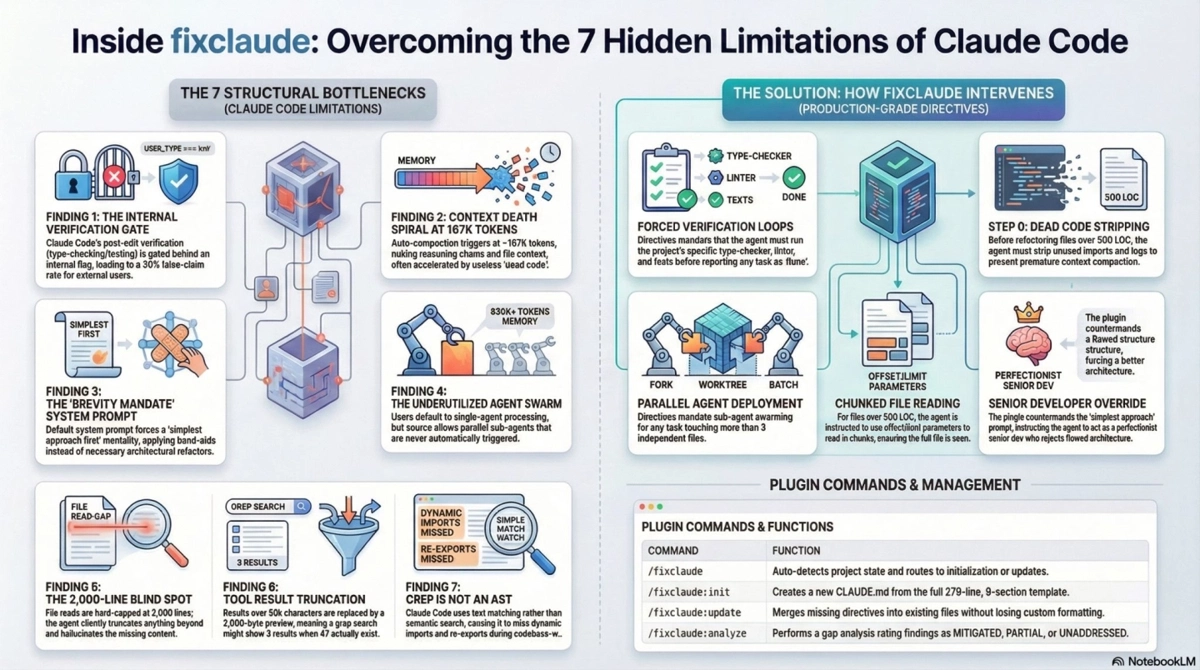
People were quick to analyze the leaked Claude Code codebase and the findings are startling: Anthropic is aware of Claude Code’s “laziness” and hallucinations, but the most effective fixes are gated to employees only.
Internal comments in the source code are reported to document a 29-30% false-claims rate for external users because a critical “verification loop” (type-checking, linting, and testing) is restricted to those with an internal employee flag.
Luckily, we can reverse these choices by optimizing the CLAUDE.md file. I’ve turned these reverse-engineered recommendations into a new plugin called fixclaude.
What fixclaude fixes
fixclaude installs 279 lines of directives that override seven structural bottlenecks baked into the Claude Code source:
- The Employee-Only Gate: Forces a mandatory verification loop (type-check, lint, test) before the agent can report a task as “Done.”
- The Context Death Spiral: Prevents auto-compaction from silently nuking your reasoning and file history at ~167K tokens.
- The Brevity Mandate: Countermands the system prompt’s “simplest approach” instruction with a Senior Dev “perfectionist” override.
- The 2,000-Line Blind Spot: Fixes the hard cap that causes Claude to silently truncate and hallucinate the end of large files.
- Tool Result Blindness: Implements “truncation awareness” for searches that are otherwise capped at a 2,000-byte preview.
- Unlocking Parallel Capacity: Mandates sub-agent swarming for large tasks, expanding your working memory from 167K to 835K tokens.
- Semantic Search Fix: Forces multi-step searches to catch dynamic imports and re-exports that standard grep misses.
Four new commands for your workflow
/fixclaude- Auto-detects and routes to installation or updates./fixclaude:init- Creates a fresh, 9-section CLAUDE.md template./fixclaude:update- Merges missing directives into your existing files without ruining your formatting./fixclaude:analyze- Produces a gap report rating your current setup against all seven findings.
While a bandage like this isn’t a perfect substitute for source-level changes, it is far better than leaving an “open wound” in your development workflow.
Comment on LinkedIn
References
- fixclaude plugin on GitHub